
Chairs are probably one of those ubiquitous things you barely think about. For the modern man or woman, chairs are truly a part of everyday life. You might sit on them, stand on them, put your clothes on them or throw them at other people, if you’re in the WWE. The one thing you probably don’t do is think about them. Well, shame on you, because there’s quite a lot you probably don’t know about chairs. Such as:
1. In ancient times, they were a luxury item
Close your eyes for a second and think. The first humans, we can probably assume, pre-dated the first chairs. One day, a forgotten hero invented the first chair. Even though the chair was assuredly primitive by today’s standards, a good deal of time and energy was likely required to fashion it. The poor society in which I will assume the inventor lived probably did not have many people devoting their time to making chairs. So, for tens, hundreds and thousands of years, chairs were something of a rarity.
How far back do chairs go? (Pardon the recliner reference.) We’ll never know for sure, but there’s evidence that they go at least as far as the Early Dynastic Period of Egypt, some 5,000 years ago.
I should also note that since chairs were a luxury item and a rarity, it’s not surprising that they were associated with prestige. Terms like “chairman” and universities’ endowed “chairs” both seem to associate chairs with positions of authority.
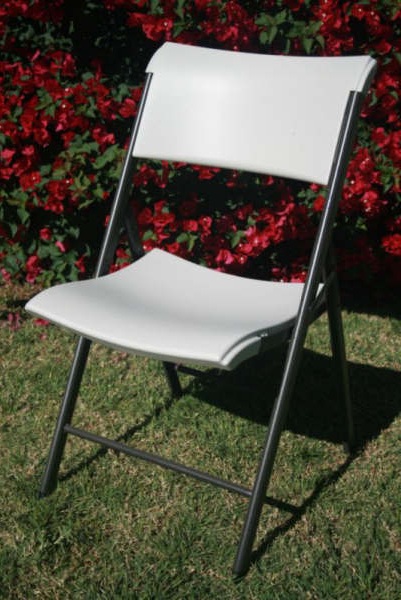
2. Folding chairs are much older than you think
OK, you’re probably thinking, chairs might go back 5,000 years, but the folding chair must have been invented around the 1930s. No offense, but you are just so, so wrong.
According to the website of the National Museum of Denmark, folding chairs were used in palace cultures of the Mediterranean some 3,500 years ago. One was even found in King Tut’s grave!
The modern folding chair seems to date back to the 19th century. This chair, patented in 1855, resembles modern folding chairs. (Note that John Cram, the patentee, says explicitly that he didn’t invent the folding chair.)
3. The British Monarchy has used the same one for 700+ years
Born around the turn of the 13th century, this chair presumably spends most of its days as a retiree – playing golf, mah-jongg, etc. But one day every few decades, it’s back in service as the (literal) seat of coronations of the British monarchy. The Coronation Chair has had that job for century upon century, going back to at least the late 1300s.
When it’s not coronating (and when it is), it lives in Westminster Abbey.
Interestingly, even when it was many hundreds of years old, the chair was pretty open to the public. According to its page on the Westminster Abbey site, there is graffiti on the chair from “Westminster schoolboys and visitors carving their names in the 18th and 19th centuries.”
4. Some chairs are actually really stupid
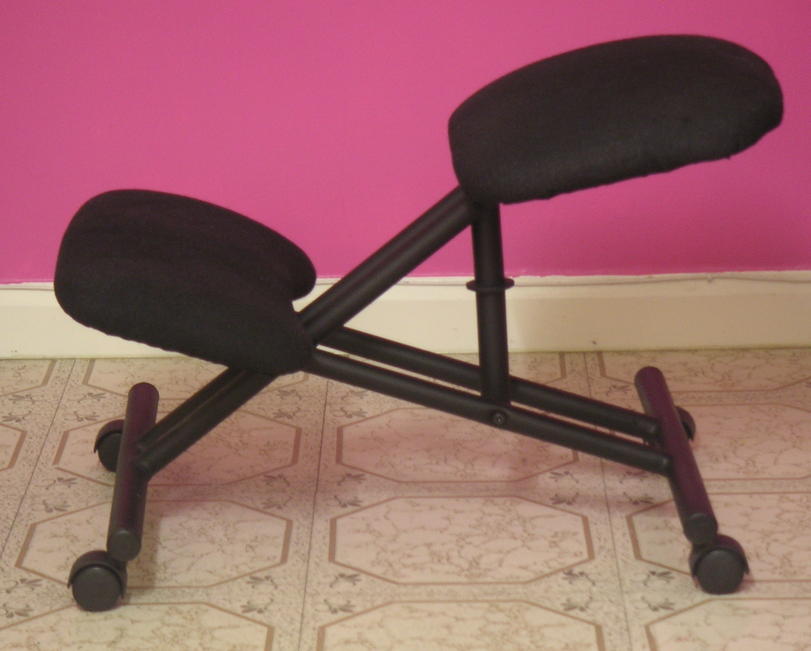
I am a big fan of chairs, but even I can admit that some chairs are actually really stupid. There are two groups of people who read the last sentence: 1) probably the majority of my readers, who are kind of confused; 2) those of you who have seen the blight on society that is the kneeling chair, who are nodding their heads in assent vigorously if not exclaiming “Thank you! I told you I’m not crazy, Barbara!”
For those of you who are judging me, I promise, I’m really pretty tolerant. Besides classic chairs, I’m generally good with office chairs, folding chairs and armchairs. I love a good recliner and don’t take issue with the ergonomics of a dentist’s chair, though I naturally dislike sitting in them for other reasons. I won’t even blow a fuse about beach chairs.
But the kneeling chair, ugh.
Let me clear about something: Chairs are generally simple. Yes, over the centuries, they have been outfitted with a variety of bells and whistles. Some now lean back. Some can move in numerous directions. But if someone time traveled here from 5,000 years ago, they’d basically know how to sit in a chair. Not so with the kneeling chair, which can be confusing enough that you don’t know where to rest which body part. Once you read the instructions and place your body in a kneeling chair, you realize that the reason they are not popular is because they will hurt numerous parts of your body, most significantly the front of your shin, which shockingly isn’t used to supporting your entire bodyweight.
In a world in which you wanted to give your back absolutely no support, inflict pain upon your shins and look like an idiot, the kneeling chair would be king. It is a pock giving other chairs a bad name. It should be relegated the dustbins of hell.
(Editor’s note: To the many kneeling chair manufacturers who we can assume will read this article. We readily admit that the diatribe contained herein lacks balance, although it does express the legitimate experience and pain of our essayist. If you would like to defend the honor of your class of chairs, reach out to the editorial team about opportunities to contribute a rebuttal.)
5. Rocking chairs are alleged to have actual health benefits
As someone who recently came into possession of a rocking chair, I may be biased toward finding the positives in these devices.
And the health claims are certainly out there. If you choose to believe what is said online, rocking chairs can ameliorate stress, chronic pain, insomnia, and balance and circulatory issues. It might even help you sleep better.
You can be skeptical if you want. You can think this is just propaganda coming from the unscrupulous rocking chair lobby. (It probably is, at least partially.)
I’m not here to give out medical advice, but it seems that at least some of these claims have some amount of truth. Notably, a 1998 study found some measurable benefits for dementia patients who rocked for 1-2 hours every day.
How broad could the benefits beyond that population be? I don’t think anyone earth actually knows, as the topic has not received significant scholarly attention to date.

