Statistically speaking, you’re probably not from Ohio. And, if you’re like at least one friend who knows I’m writing this article, you’ve never even thought much about Ohio and are okay with that. Well, you shouldn’t be. Fact is, the Buckeye State is notable in several different respects, such as…
1. There were more presidents born in Ohio than in any other state
If you look this up, you’ll probably read that Virginia was the birthplace of more presidents than any other state. That’s not exactly true. While seven presidents were born in Ohio — Grant, Hayes, Garfield, Benjamin Harrison, McKinley, Taft and Harding — and eight were born in “Virginia,” that mode of analysis ignores a critical fact: Virginia wasn’t a state when most of those presidents were born. I have no issues with Virginians taking civic pride in the legacy of George Washington, but the simple fact is that he (and many of his fellow Virginia-born presidents) were born in the colonial era, before Virginia was a state.
If you’re tallying up which state had the most presidents born within its current boundaries, Ohio is second to Virginia. But if you’re counting which state had the most presidents, Ohio comes in first.
2. Ohio once had a war with Michigan
You probably didn’t even know that individual states could go to war, and I don’t believe any other state conflict was dubbed a war (other than the Civil War). But this one was.
Like so many conflicts, this war was focused on a land dispute. Ohio had become a state in 1803, so its border should have been firmly established by the 1830s. Alas, this was the early 19th century, and precision in surveying was wanting.
Essentially, Ohio’s northern border was defined by Congress in relation to the southernmost point of Lake Michigan. However, Lake Michigan being some 100 miles west, there was dispute about how far south the border went. There was already uncertainty in 1803, but Ohio operated under the assumption that its northern border extended relatively far north, which put the strategically located city of Toledo and a sizable amount of the Lake Erie shoreline within its jurisdiction.
When Michigan — directly north of Ohio and the other claimant to Toledo — tried to become a state in the 1830s, it included Toledo and the other disputed territory in its proposed borders.
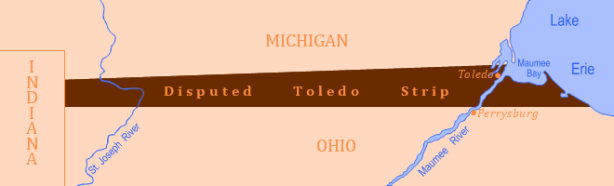
With both states claiming the 438-square-mile “Toledo Strip” as their own, things got ugly. In spring 1835, the governors of Ohio and Michigan (still a territory) marched hundreds of soldiers toward the disputed territory. While no blood was shed, the ensuing months saw a succession of skirmishes between Ohio and its northern neighbor. When a Michigan sheriff tried to arrest Ohioan Benjamin Stickney in July, the latter’s son stabbed the sheriff. This non-fatal stabbing seems to have been the only injury sustained in the conflict.
Ultimately, Congress agreed to accept Michigan as a state if it relinquished its claim to the Toledo Strip and took the bulk of the Upper Peninsula in its stead. (You’ve likely seen the Upper Peninsula on a map. It’s the significant piece of land that looks distinctly like it shouldn’t belong to Michigan.)
3. Ohio has been a powerhouse of industry, sport and more
Every state can lay claim to some impressive lore and legend, as well as a handful of residents who helped shape history. Ohio just seems to have so many. From the Wright Brothers, who invented the airplane, to Thomas Edison, who invented the light bulb and phonograph, to Neil Armstrong and John Glenn — perhaps the country’s two most famous astronauts — the story of American innovation can’t be told without the Buckeye State.
Meanwhile, professional baseball began in 1869, with the Cincinnati Red Stockings as the first professional team, and the National Football League was founded in Canton, Ohio, where the Pro Football Hall of Fame is situated. The Rock and Roll Hall of Fame is also located in Cleveland.
Ohio also claims credit to Albert, Sam, Harry and Jack Warner — the original Warner Brothers — who lived in Youngstown, Ohio for some years, and first dipped their toe into the entertainment business with the purchase of a Youngstown theater.
4. You can’t tell the story of Ohio without the letter C
If you look at each state’s largest three cities by population in the 2020 census — a total of 150 cities — 17 of those cities start with the letter C. With just 17 of these cities to share among 50 states, it’s not surprising that Ohio is the lone state that has a clean sweep of municipal “C”s: Columbus (the state capital), Cleveland and Cincinnati are the state’s three largest cities.
Naturally, the name of the state’s first capital, Chillicothe (Ohio’s 76th biggest city by 2020 population), also begins with a C.
5. Ohio played a very influential role in the Civil War
Both my gut and Google Maps show Ohio as being within spitting distance of Canada, so it was obviously a northern state, and it was a critical one at that. Centrally situated within the Union, Ohio’s railroads and rivers were integral for transportation of goods and manpower across the North. Ohio’s population also played an outsized role in the war — it contributed more soldiers per capita to the Union Army than any other state. When the war ended successfully for the Union, the army’s three top generals, including General Grant, all hailed from Ohio.
 The Classic W
