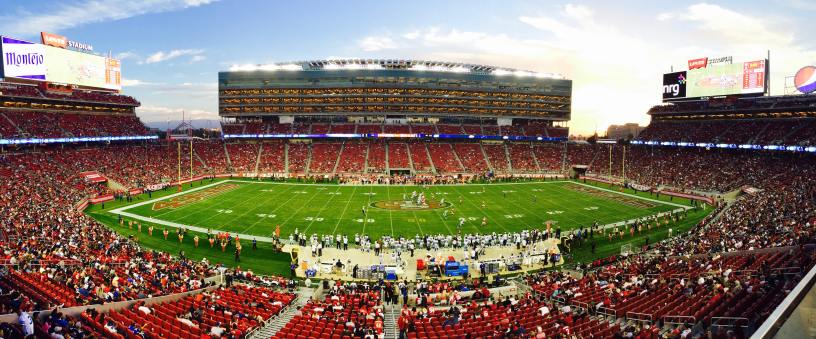
If you’re a football fan — or if you’re not a football fan — you probably know that the Super Bowl is today. Dating back more than 50 years, the big game has become a significant part of American culture; the on-field competition is popular, of course, and when you add in the commercials, half-time show and more, it adds up to one of the most highly-anticipated dates of the year for many Americans. Even so, there are probably some things you didn’t know about the Super Bowl, including:
1. It’s not an accident that it kind of sounds like “super ball”
You remember super balls – you might have played with one of the bouncy rubber things when you were a kid. Apparently, Kansas City Chiefs owner Lamar Hunt remembered them too when he coined the name for for the big game. It was in the 1960s, and a number of team owners were discussing the details for what we now for the football championship. In Hunt’s words (via the St. Petersburg Times):
Every time we mentioned the game itself, we used a different name. The “big game.” The “final game,” “the championship,” and so forth. Then one day I just happened to call it the Super Bowl. It just seemed natural. I don’t know how I came up with it. I think it must be related to a ball which was popular with kids at the time…You could bounce it over a house…So we got Super Bowl from super ball. Kinda silly, isn’t it? I’m not proud of it, but nobody’s come up with anything better.
Even NFL commissioner Pete Rozelle didn’t like the name, saying “it can obviously be improved upon.” But while Hunt and Rozelle didn’t think much of the name, it took off. Within a few years, “Super Bowl” had become the official name of the game.
2. It is the second-biggest eating event of the year
It’s no surprise that Americans eat a lot while watching the Super Bowl, but you might have not known that, in terms of food consumption, it is bested only by Thanksgiving. Just how much food do Americans buy for the Super Bowl? Well, according to at least one source, the country’s collective Super Bowl spread includes over 1 billion chicken wings, almost 140 million pounds of avocados, 10 million pounds of ribs, 8.2 million pounds of tortilla chips and 3 million pounds of nuts.
Supposedly, Americans also guzzle some 300 million gallons of beer, but there’s plenty of reason to be skeptical of that figure.
3. Once — and just once — a losing player won the MVP
Within the world of sports, there is a debate about whether a player has to be on a winning team to be considered the most valuable player. “How valuable could he be,” some wonder, “if the team didn’t win despite his efforts?” Or even, “they could have lost just as well without her.”
At least in 1971, that thinking did not dominate.
The fifth Super Bowl was a battle between the Colts and the Cowboys that took place in Miami. It was a sloppy game and Cowboys’ linebacker Chuck Howley did everything he could to propel his team to victory, making two interceptions and recovering a fumble. The Colts got 10 in the fourth quarter to pull out the victory, but Howley was recognized for his yeoman’s work on behalf of the Cowboys. Five decades later, he remains the only losing player to be named MVP of the Super Bowl.
4. The 2015 game was the most-watched broadcast in U.S. history
In 2015, Super Bowl XLIX — an exciting battle between the Patriots and the Seahawks — was viewed by an average 114+ million people, setting the all-time record for a U.S. television broadcast. Of the 11 TV broadcasts that reached an average 100 million people, 10 were Super Bowls; the 11th was the series finale of M*A*S*H.
5. It’s usually in the LA, Miami or New Orleans metro
It’s obvious that a warm climate makes a city a more obvious destination for the Super Bowl, but the dominance of the LA-Miami-New Orleans triumvirate is noteworthy. Remember, some Super Bowls have taken place in frigid northern states — Minnesota, Michigan and New Jersey — and others in in-between climates like California’s Bay Area. Also, it’s not as though there are no warm climates outside of the Super Bowl’s big 3: Nevada, Texas, Georgia and Arizona have each hosted Super Bowls of their own. Still, Los Angeles, Miami and New Orleans have managed to get the nod in more than half of the contests.
 The Classic W