Over the centuries, America has had many tales of conflict, and the stories of Hamilton-Burr and Lincoln-Douglas are not likely to be forgotten as long as American history is told. But competitions don’t always occur between two individuals. And in the earliest days of this country, one notable conflict was the one between the north and the south — a conflict that can perhaps be characterized by that between Virginia and Massachusetts.
The two states were natural rivals. Both were among the most influential colonies. Both boasted major educational institutions (Harvard in Massachusetts, and William and Mary in Virginia). At the time of the revolution, both colonies went back in one form or another well over a century (other colonies had much less lengthy histories of European settlers). Not surprisingly, politicians from the two states dominated early American politics — four of the country’s first six presidents hailed from Virginia, while the other two were Massachusetts natives.
But while political intrigue is exciting, in this column we will specifically focus on and analyze the use of the two terms, “Virginia” and “Massachusetts.”

Using Google’s Ngram Viewer tool, which compares the frequency with which different terms have been used in published works, we can see that “Virginia” has led “Massachusetts” in print citations for a full 150 years. “Massachusetts” had just a few glory years leading up to the Civil War, but has otherwise had to settle for second place in this conflict.
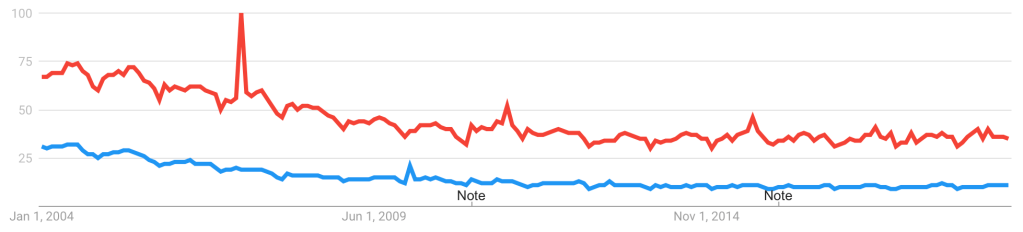
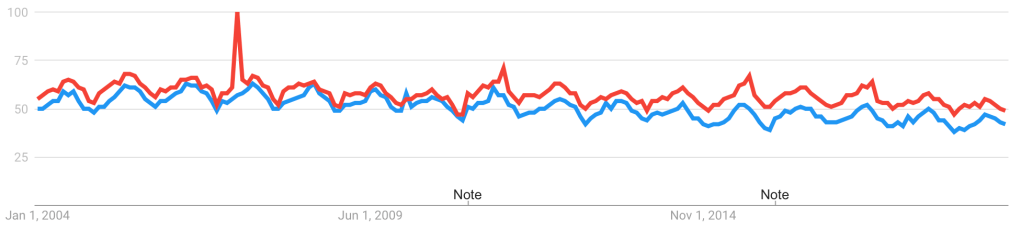
“Virginia”‘s dominance extends to web search results, as well. The above analysis by Google Trends — which ranks the frequency of search terms on Google Search — shows “Virginia” (red) leading “Massachusetts” (blue) by a sizable margin in every month since 2004.
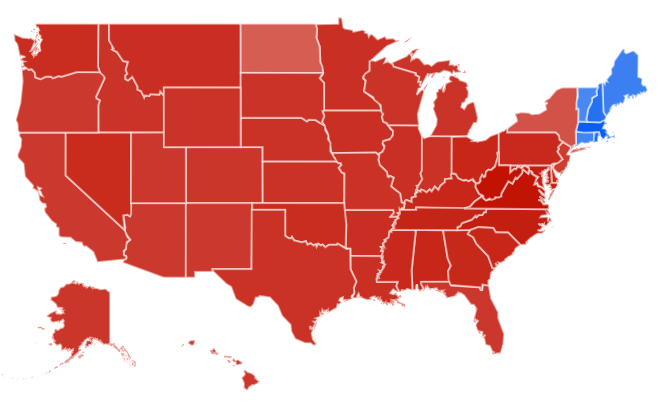
It is no surprise that these search results are influenced by geography. As seen above, while 44 states search for “Virginia” more often, the six New England states are more likely to search for Massachusetts.
In the graph above, the shades of red and blue indicate the degree to which the relevant search term dominated — for example, “Massachusetts” dominated its own state by a wider margin than “Massachusetts” dominated searches in Vermont, and Vermont is therefore marked in a lighter shade of blue.
What struck me as odd was the lightest shade of red on the map, i.e. the most “Massachusetts”-skewed state outside of New England. Instead of being a state with some proximity (or other obvious tie) to Massachusetts, it is North Dakota. Digging deeper, the findings are even more curious:
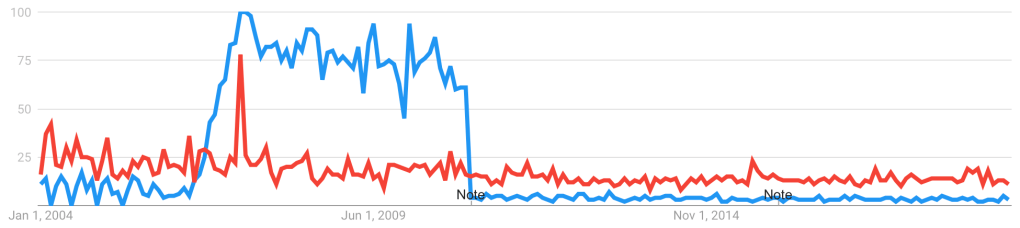
From 2004 to mid-2006, and again since early 2011, North Dakota echoed the national trend and clearly favored “Virginia.” But for four-plus years, the state had a much, much higher search volume for “Massachusetts.” Drilling down geographically, it should be noted that this trend seems to have been driven by search queries in the western portion of the state.
Why this occurred is worthy of discussion, but at this writing, no immediate reason has been found. One imagines that there was likely something skewing the data, whether that was some sort of server farm in North Dakota processing search queries from New England or a Massachusetts-based company with a Minnesota outpost for several years.
Before we conclude, it should be noted that we would do poorly to misunderstand the data. While this is always true in data analysis, it seems particularly important to note here because several factors (of varying significance) are likely boosting “Virginia”‘s score:
- In addition to being a state, Virginia is a name
- In addition to Virginia, since 1863, West Virginia has also been a state. Presumably, this bolsters Virginia’s ranking as any reference to West Virginia includes the word “Virginia.”
- Massachusetts is quite a lengthy state name; it is often abbreviated, and has likely been misspelled countless times (misspellings presumably don’t count toward the ranking).
That said, Google Trends does provide us with a tool that attempts to tease out some of these “biases.” While it is hard to know how effective this is, Google does give the option of searching for a “US State” instead of a “search term”. Comparing the “US States” of Virginia and Massachusetts, we see a much, much tighter race, although North Dakota is still one of just two states outside of New England to favor Massachusetts.
 The Classic W