For generations, one of the more underrated domestic conflicts in the United States has pitted thousands upon thousands (perhaps millions) of children against vegetables. And while the battle may be profound when it involves carrots, radishes and celery, perhaps no two foods better epitomize the struggle than spinach and broccoli. In this edition of “Word Wars” we ignore the children, and instead explore how these two vegetables compare to one another.
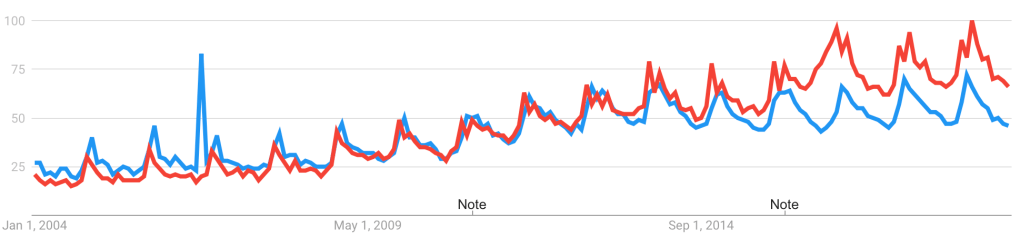
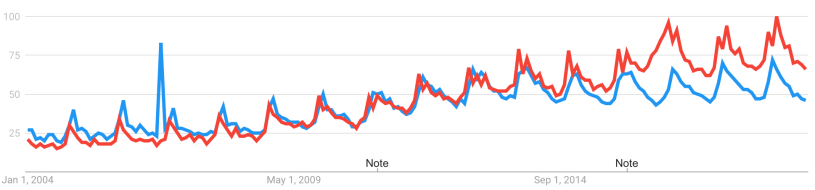
The above chart from Google Trends shows how spinach (blue) and broccoli (red) compare with respect to search frequency in Google Search since 2004. For the first few years, spinach was the more popular search term on a regular basis, outpacing broccoli nearly every month. For a period of years — from about 2009 to 2014 — the two terms were neck and neck. However, “broccoli” has had the lead in every month since January 2014.
Of course, it should be noted very clearly that this measures the popularity of search terms, not the popularity of the vegetables. (And, of course, searches for things like the song “Broccoli” by Lil Yachty can muddle the results.)
In the first decade of this sample, the highest showing for either term was in September 2006, when “spinach” was searched more than four times as much as “broccoli.” But that spike was not due to any affinity for the vegetable — in September 2006, the United States was rocked by an E. coli outbreak in spinach, which caused hundreds of illnesses and three deaths, and was also, assuredly, the cause of the Google Search spike. One could even speculate as to whether that outbreak (and a smaller salmonella issue in spinach in 2007) ultimately caused a comparative waning in the popularity of spinach vis-a-vis broccoli.
Another takeaway is that “broccoli” and “spinach” seem to thrive in different months. While both terms generally do well in the fall and early winter, broccoli’s high points tend to be November and January; spinach, on the other hand, does particularly well in December. Broccoli’s strong showing in January may reflect New Year’s resolutions and ambitious health plans.
Over the past 15 years combined, 49 of 50 states have favored “broccoli”, with Hawaii serving as the lone holdout. Examining the findings on a more granular level, however, is of much greater interest.
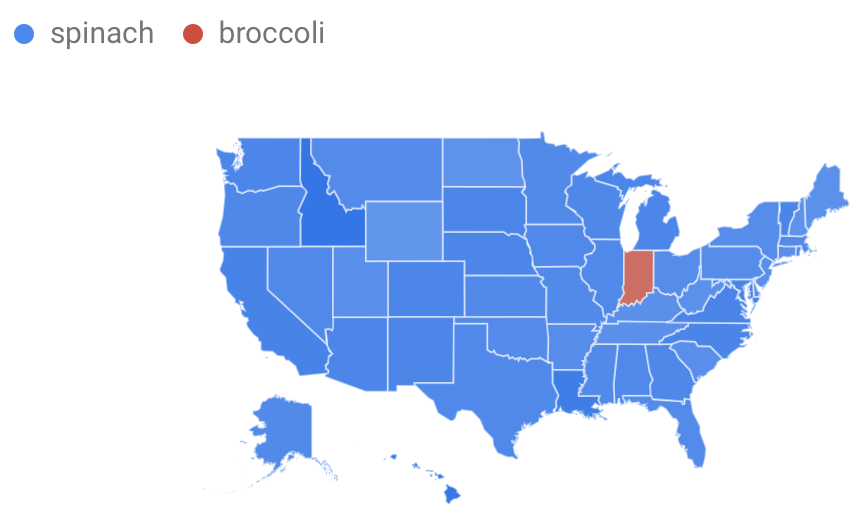
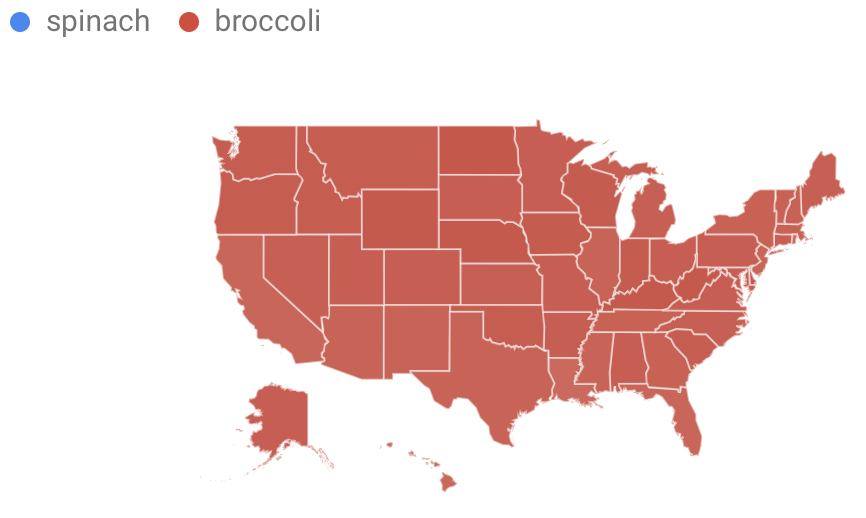
If you go back to 2006 (above, left), 49 states favored “spinach” (the one exception was Indiana). But in 2016 (above, right), all 50 states favored “broccoli” in their searches — quite an about-face!
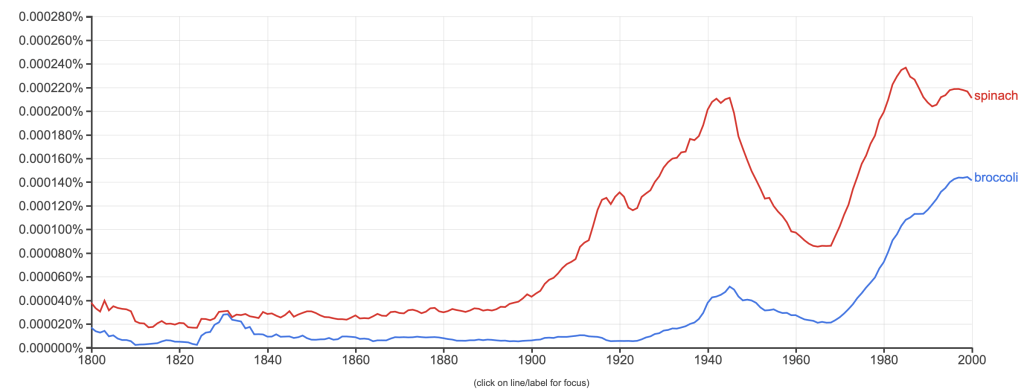
It should be noted that Google Book’s Ngram Viewer (above), which analyzes the frequency of words published between 1800 and 2000, shows “spinach” with a clear advantage. Outside of a few years in the first half of the 19th century when the terms were very close, “broccoli” lagged well behind “spinach” for two centuries.
Author’s Note: In case you are wondering about cauliflower, which some think of as just a pale version of broccoli, “cauliflower” ranks behind “spinach” and “broccoli” in Google Search on a pretty consistent basis. It fares somewhat better on Ngram Viewer, but much of that is historical weight; it has trailed the other two vegetables since the early 1980s.
 The Classic W